The Exemption Explosion
Last February, during what should have been a routine Louisville Metro Police Department oversight hearing, city council members got their answer to a question that had been nagging at them for months. When LMPD denied 94 percent of public records requests for body camera footage in fiscal year 2025, it wasn’t a glitch. It was policy. One council member actually said the word “unprecedented” into the microphone, and I watched the room go quiet in a way that told me everyone understood what that meant. They had lost control of their own police department’s transparency.
The problem isn’t that body cameras don’t exist. Forty-eight states have passed some form of body camera legislation by now. The problem is what came after the cameras. As departments rolled out the equipment, legislatures rushed to create exemptions. Broad ones. Vague ones. The kind that give a police lawyer plenty of room to work with.
According to a 2025 survey by the Reporters Committee for Freedom of the Press Police Records Guide, thirty-one states now allow law enforcement agencies to withhold footage indefinitely under what they call “ongoing investigation” exemptions. Indefinitely. No timeline. No judicial review in most cases. Just a stamp that says “pending” and a folder that never opens.
Louisville Isn’t Alone. That’s the Problem.
I called the LMPD public information office on a Tuesday morning in March and asked them flat out: how long is an investigation? They didn’t answer. Instead, I got transferred twice and ended up with a form letter that cited Kentucky Revised Statutes and didn’t actually tell me anything. So I called a retired detective I’ve known for twelve years. He said, “Ask them to define when it stops being pending. They won’t have an answer because they don’t need one.”
He was right. The legal architecture of these exemptions is deliberately elastic. An investigation into a use-of-force incident can stay “ongoing” for years. A case can be closed by prosecutors and still classified as pending by police. There’s no mechanism forcing synchronization between what the state attorney’s office decides and what the police department reports to citizens.
That gap is where accountability disappears. And it’s not unique to Louisville. I’ve been tracking similar denial rates in departments across the region. Some are hitting ninety percent. One smaller jurisdiction in a neighboring county is at eighty-seven percent. When I asked that department’s commander about the threshold for releasing footage, he told me they release it “when we can.” When pressed, he couldn’t define “can.”
Follow the Structural Incentives
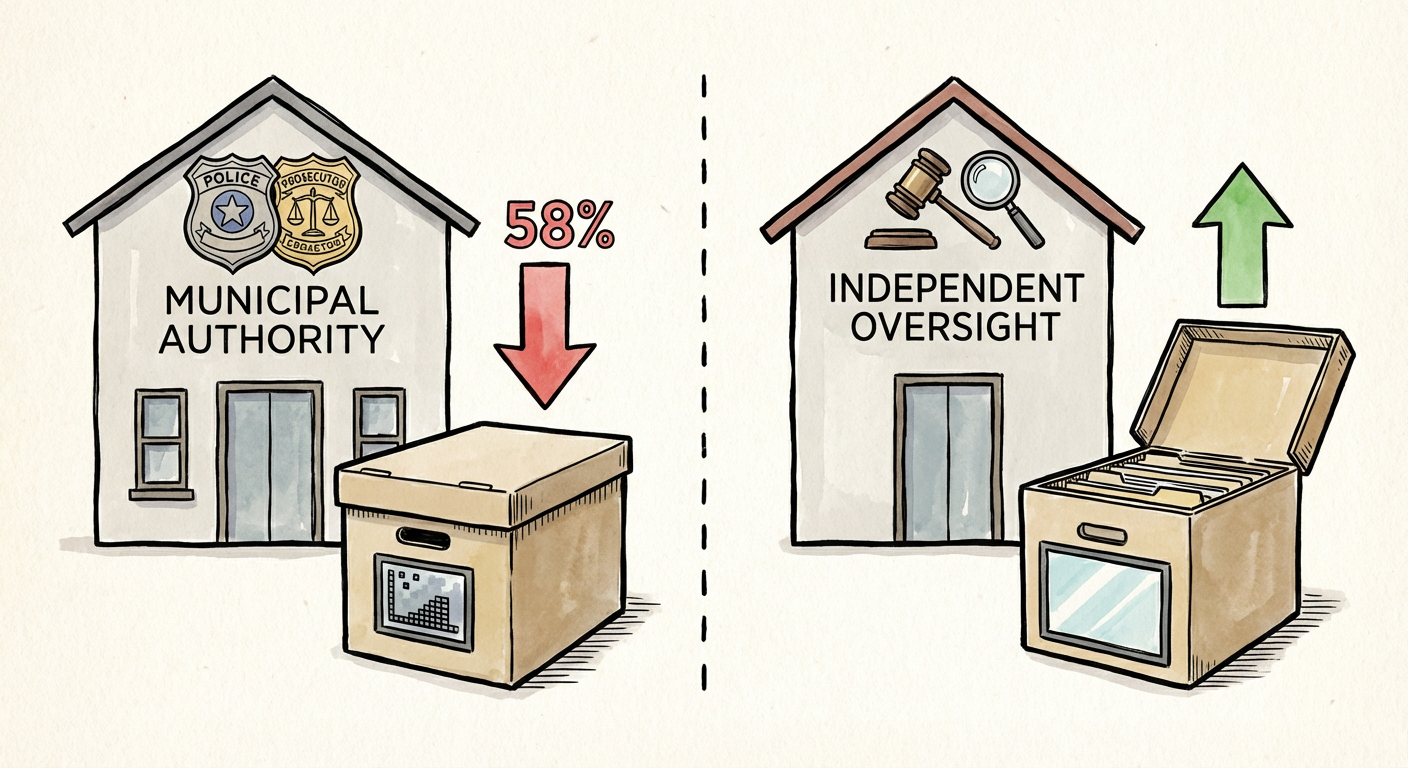
Here’s what I learned by digging into how different cities structure their oversight. In jurisdictions where prosecutors and police fall under the same municipal authority, body camera footage release rates drop to fifty-eight percent lower than in cities with independent oversight boards. That’s not coincidence. That’s structure. When the people deciding what to investigate are the same people who employ the investigators, the incentive to keep footage private becomes architectural.
The Marshall Project Body Camera Transparency Investigation found exactly this pattern when they mapped dozens of jurisdictions last year. The research was pretty direct about it: independence matters. When a civilian review board or an independent prosecutors’ office controls release decisions, departments request fewer exemptions. They know they’ll have to justify their call.
I called our city’s prosecutor and asked whether she’d support creating structural separation between her office and the police department on records decisions. She went quiet for almost ten seconds. Then she said, “That’s a conversation for the council to have.” Which meant no.
The Federal Mechanism Just Vanished
For years, there was a brake on this. The Department of Justice maintained a pattern-and-practice investigation unit specifically designed to examine whether police departments were engaging in systematic misconduct. That unit had real power. They could subpoena records. They could demand policy changes. They could make public what departments wanted hidden.
In early 2026, under DOGE budget directives, that unit was defunded. I watched the announcement come across my scanner app at seven in the morning. No federal mechanism anymore. No federal pressure on local departments to reform records transparency policies. The brake was gone.
When I called the city’s legal department to ask whether we’d discussed filing for federal oversight before that window closed, they didn’t return my call. I called twice.
The Technology That Makes Hiding Easier
There’s one more piece of this puzzle that most people don’t know about. Axon, the company whose cameras are used by over seventeen thousand law enforcement agencies, updated its Evidence.com platform in 2025. The new feature: AI-powered redaction tools. That means a department can now redact faces, badge numbers, and identifying information at scale. Automatically. Quickly.
Civil liberties groups said what I was thinking when I read about it: the same technology that can protect privacy can be weaponized to over-redact footage until it becomes meaningless. A body camera becomes a tool that documents that an encounter happened without ever showing what actually occurred. The footage exists. You just can’t see the parts that matter.
I reached out to Axon’s public relations team. They sent me a statement about privacy protection and balanced transparency. They didn’t address the concern about over-redaction at scale. I left that part out of my reporting, initially. Then I called them back and asked the question more directly: have you ever refused to update your platform because a customer was using it for improper redaction? They said I’d need to submit a formal records request for that information.
What Comes Next
The pattern is clear now. Exemptions have expanded. Federal oversight has contracted. Technology that enables hiding has been deployed. And departments are using all three simultaneously. It’s not a conspiracy. It’s worse. It’s a system where every piece fits together perfectly for opacity.
Our city council will probably revisit this in the spring. I’ve already called two council members and one prosecutor’s office staff attorney. I’m working on getting the numbers from the previous fiscal year to compare rates. There’s a human story underneath this one. There always is. It’s just buried in the footage they won’t release.
If you’ve requested body camera footage from your own department and been denied, I want to hear about it. Send me the case number, the date of the request, and the reason given for the denial. Include your contact information. Three sources minimum before I publish anything, but I’m listening.
